Monday, July 29, 2013

garden tour, 2013

Sunday was the annual Anchorage Garden Tour, when, for five hours several local gardens are open for public viewing. Two years ago I biked it with my friends, Corinne and Paul, so when Corinne said it was coming up, I jumped on board. A few other friends decided to join in.

Seven of us gathered with our bicycles at a local park and headed off to the first garden, in the Airport Heights neighborhood. We visited four more gardens in Turnagain, and then a final garden on the shore of Sand Lake, just south of Raspberry Road. The day was warmer than I expected with no need for the rain gear I'd packed. I was glad a couple people brought sunblock because that was not even on my radar. Along the way, we biked neighborhood streets and greenbelt trails. We even had a picnic lunch in a park across from one of the gardens. All told, I biked 30 miles. But it wasn't about the mileage, it was about the gardens.

What I love about visiting the different gardens are all the ideas I pick up and stash away for later, i.e., that day when we are finally ready to start dealing with the landscape in both the front and back yards. Meanwhile, here are some ideas I liked:

Rain-gutter garden!

Painted furniture (and no lawn to mow!)

Outdoor art on the garden shed.

Umbrella to make mini-greenhouse!

Corinne matching the poppies!

Hen house (though that screened area looks like a perfect place to write!)

Choose one color; now it becomes all about shapes & textures.

Close-up.

My shadow & I love this angled planting!

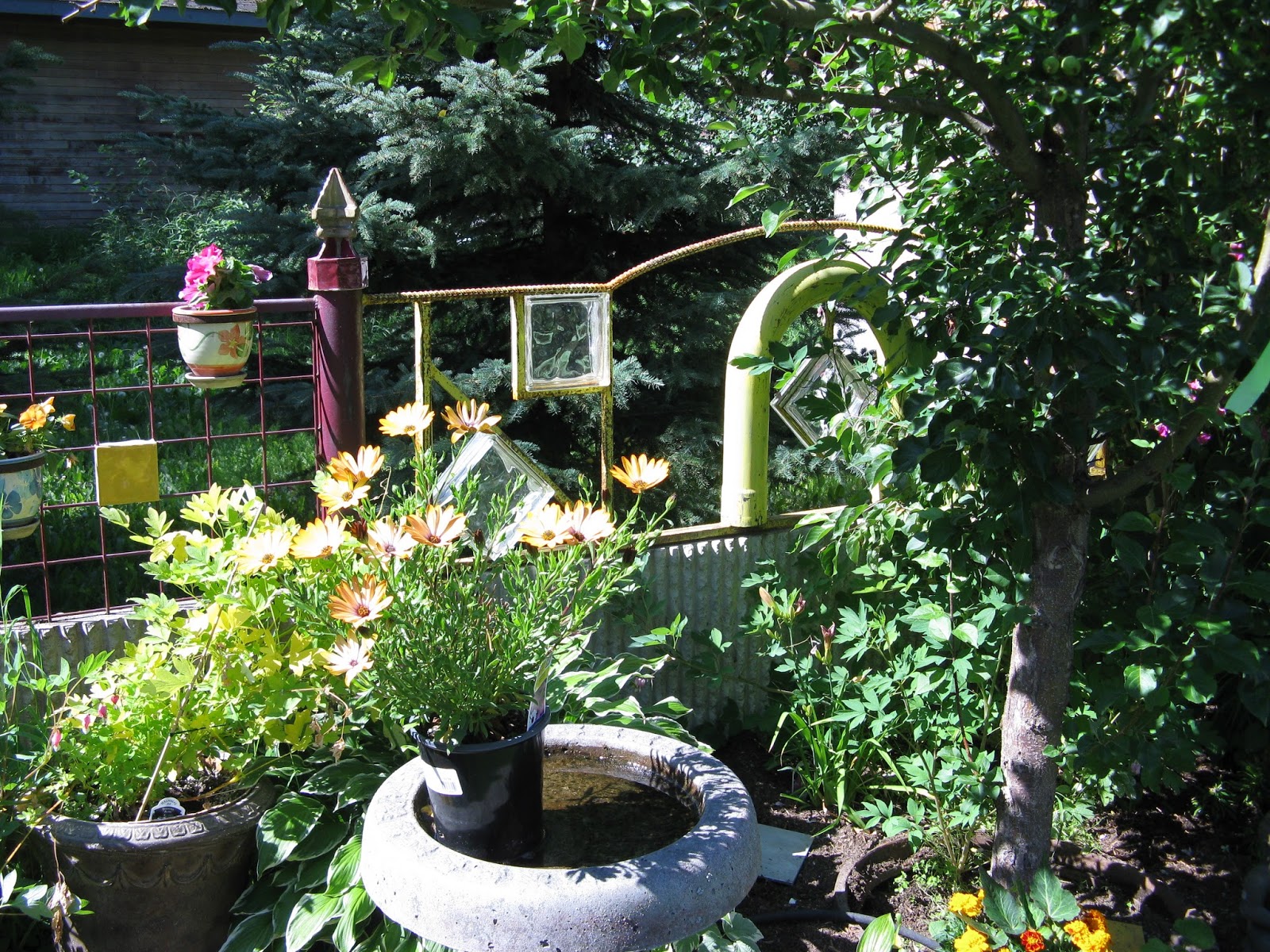
Fence made of reclaimed metal with tile & glass, paint accents.

Watermelon berries!

Nice kitty.

It's patriotic to re-purpose your old sports equipment!
(Be careful of the black arm rests on a sunny day!)


I'm claiming the hammock and the float plane!

Friday, July 26, 2013

rough terrain

Something from last week has been on my mind. While Jon and I were driving to Seward for our weekend camping trip, I brought up something that happened earlier in the week. Along the shores of Turnagain Arm, just south of Anchorage, a woman's body was recovered.

Her name was Martha and she was someone Jon had known years ago, having dated Martha's then-roommate. I had met Martha a few times through the Alaska Women's Environmental Network (AWEN) and at the Alaska Center for the Environment (ACE). But neither of us knew her well. When a news report had listed her as missing, I worried. Her husband had said she was "despondent," not answering her phone, hadn't shown up for work. They found her car, then they found her body.

As we drove along the Arm, I told Jon how I wondered what the husband had meant by despondent, because in the past few weeks I'd had days in a row where I felt so low that even riding my bike didn't interest me. I'll admit now that I didn't answer the phone. I did go on a hike with one of my friends and when it didn't cheer me up, I told her I'd had a problem with this depression for a long time. She asked for how long and I told her since I was a teen. My friend seemed to not know what to say. I wondered if I'd made a mistake or maybe she just needed to think it through. A weight settled inside me and we dropped the subject. I've never told any of my other friends about my depression. Jon is the one who sees it, encourages me, knows that at times I am inconsolable. Listens to me when I tell him "This is not how normal people are!"

Now I was scared. What had happened to this woman who had been a light in the community, a leader, a warrior for the environment? What about me? What was to stop me from getting to that point where I could not go on?

Jon asked if any of my friends knew Martha, and because I use social media a little more than I like to admit, I told him a few were. Why not ask them if she had a problem with depression, he suggested. I was doubtful. Look at me, I reminded him. I tell nobody. Throughout our lives, we act. We have our public side, then we have the side we show our partner and very few others - if any. Jon and I talked about why this is the case. And what we agreed is that people with depression are afraid we will be judged. Judged for being weak; for not appreciating all that is before us; all that we have; be it family or friends, possessions or just a brilliant summer day.

Two weeks ago, I was very down. There was little that would make me smile. I didn't want to smile. My energy was drained, but I convinced myself that I should do some research and the book I needed was at the library on the university campus where parking is pricey. I dragged myself out of the house, climbed on my bike and rode the few miles to the Consortium Library (where I discovered that I'd forgotten my note with the book title, forcing me to speak with another person). Eventually I found the book, checked it out and biked home.

I rode through a route that goes between my street and the nearby school, through a cul-de-sac to an intersection. As I made my turn, something in the rock garden on the corner caught my eye. I hit my brakes. Two perfect boletus mushrooms were pushing through the loosened soil. I looked at them. Allowed a smile. I considered picking them, wondered if my neighbors knew what deliciousness was growing in their yard. I left them, in case the family planned to pick them for dinner. Later in the evening, when Jon called to say he was leaving the shop, I told him to be sure to bike past that house and notice the rock garden. He arrived not an hour later with not two, but three mushrooms from his ride.

These little unexpected moments of joy can pull me from my malaise as if a switch has flipped on a light. I've often wondered if these deep canyons in my mind magnify those moments of soaring happiness. Do I experience life's highs more intensely because of the mental distance traveled to get there? Because when I'm in that headspace, I can see that this is indeed a beautiful world.

But just like knowing that the day-after-day sunny weather we've had this summer will ultimately end with skies that cloud and bring rain, I know the down days will return. I will wonder again how many days the darkness outside or within will last. I will try to keep myself busy. Try to not leave too much time to ponder my failings, my inadequacies, my insecurities, disappointments. Those things that lead to the downward spiral. I will try to focus on the positive moments for as long as I can. Try to link together as many good days as I can, continuing to focus on the simple beauty around me.


postscript:
It has taken me a few days to write this and I'm still nervous as hell about posting it. I did call a friend who is listed among Martha's friends on social media. While their interests sometimes overlapped, they were acquaintances and he had no knowledge of the struggles Martha went through. I'm glad I spoke with him. He's a writer and a teacher of writing, an observant and generous person. Though it was tough sharing with him my reasons for being concerned, his encouragement told me I needed to complete the thought.

For my friends who may be worried, I'm mostly okay, though I've found it's much easier to mend a shoulder than a mind and not nearly as hard to speak of a physical ailment than a mental one. I realized as I was riding my bike on some trails this Wednesday that part of what compels me to share this story is this relationship I have with words. If I can give voice to these feelings; if I can speak its name; if I can call it out; if I can tell the world it's lurking, maybe I can take away its power. So, call it my flip-off to Depression. There. I've said it's name. Yet I am so nervous about hitting the "publish" button, the real moment of truth.

post postcript:
We've had a couple rain storms in Anchorage in the last two days. I'm okay with that.

bike camping

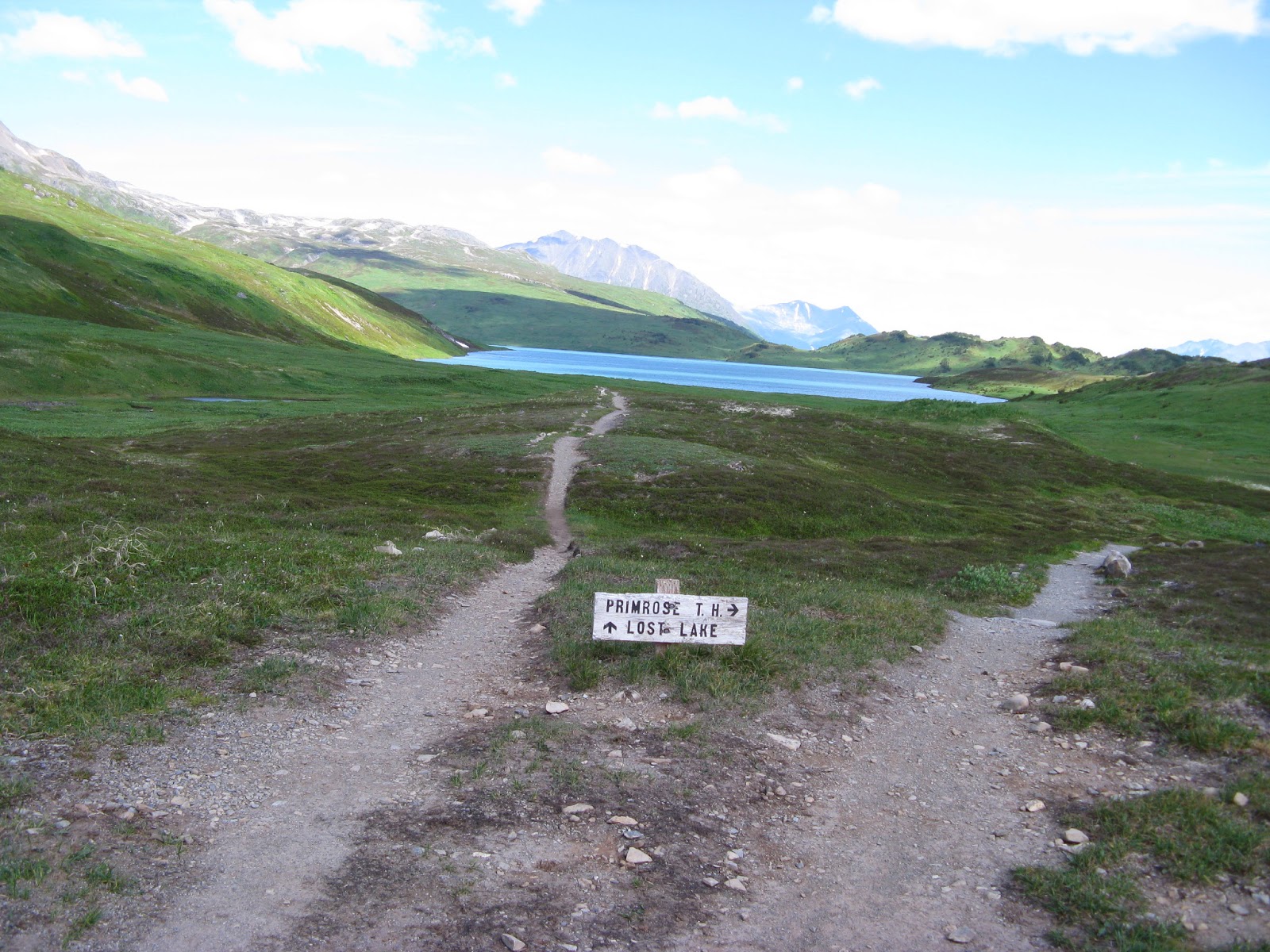
Last Friday Jon and I celebrated our 15th wedding anniversary. After talking about a few options, we decided to drive toward Seward with the bikes and camping gear in the car, then bike up to Lost Lake. We've biked the entire length of the trail several times and I've long wanted to spend the night camping there. I figured seven miles to the lake would be very manageable as a first camping trip of the year. In fact, it was to be my first camping trip since 2011! I was ready.

We hit the trail just before 7 p.m. with Jon pulling the BOB trailer while I went light with rear panniers and my Camelbak. Parts of the trail were steep and sloughing away. In a couple places it was verging on being overgrown. Several times I got off to walk a rocky or otherwise sketchy section, pushing the bike or lifting the back end over something. After a few miles, the trail emerged from the trees and became a winding path, mostly rideable - even the elevated boardwalk, which I cleaned without thinking (best leave the thinking out when getting ready to ride the narrow planks).

Jon bikes toward the lake; Resurrection Bay in the background.
Approaching Lost Lake at 9 p.m.
Near the high point, the wind was kicking up but I rode in short sleeves toward the south end of the lake. After a little wandering we found a level campsite high above the lake and slightly sheltered from the wind. Despite mosquitoes buzzing on the outside of the tent, we eventually got to sleep.

11:15 p.m., shortly before turning in for the night.

Home for two nights.
The next morning, we woke to sprinkles on the tent, but soon the rain moved away (apparently headed for Anchorage, we later heard) and I climbed from the tent to make coffee. There is something perfect about sitting with a cup of coffee in the great outdoors, watching the morning light play on the lake. After breakfast and a few chores - like pumping water through our filter to fill our packs - we started out on a hike.

The bridge we didn't need to cross with bikes and gear.


Our goal was to circumnavigate the lake. We didn't know if it was possible; rather, we didn't know how far upstream to the headwaters of the lake we would need to go to make a safe stream crossing! Eventually we crossed just above a melting snow slide and where the creek braided. Jon went barefoot and I just kept my boots on - only a little water crept over the tops and I was mighty happy that I had better footing as we crossed.

Ptarmigan.

We found a cave!

Was it a mine? I wonder.

Little white flowers.

So many wildflowers!

Headwaters of Lost Lake. We'll cross on those gravel bars.
Heading back to camp
A few hours later we were back at camp, devouring dinner and wine (after briefly soaking our feet in one of the ponds) before turning in early. Exhausted.

On Sunday morning, we had a leisurely morning of coffee and breakfast. We watched from our perch as several hikers walked by. We would pass them later on our descent after our before-the-crack-of-noon start. We would also run into several cyclists we knew, most from Anchorage, who were riding the trail the way we usually do: as a day trip, maybe with a lunch stop in view of the lake. I took my time on the descent, stopping a few times just to rest my hands from the almost constant braking. Jon pulled away from me and I watched the BOB trailer bounce down the rougher sections of trail. We finally arrived in the parking lot, brimming with cars on a hot, sunny day.

I was pretty happy with how the Fargo - not to mention my shoulder - handled on the trip. I think I'm ready to tackle the Continental Divide!

Until next time.

Friday, June 28, 2013

repeats

Here we are, a misty rain falling and words piecing themselves together. The sun and warmth have been wonderful in Anchorage, but my writing inspiration has been nil. Let's see, besides work and volunteering at the museum, here's a little of what I've been up to.

I've been mountain biking and thinking an awful lot about technique. Earlier this month, my biking group hosted a clinic for its members at Kincaid Park. We had a young man teach us a few things about riding singletrack, specifically, how to best ride the many banked corners that were built on the new trails in 2011. Kevin is a talented rider, a soccer coach and recently earned his degree in phys. ed. He knows how to break down the elements of trail riding and express them to a group in a way most riders cannot.

After a discussion and brief warm-up, Kevin watched as each rider pedaled through a short stretch of trail near one of the parking lots; then, he told us what he saw and described how to improve. Most important was not hitting the brakes while in the midst of a banked corner, at least not if you're riding at all high on the bank. Instead, tap the rear brake only before entering the corner, then ride it out. Tapping the brakes while in the corner could slow momentum and drop us down to the low spot on the trail, maybe causing a crash, he warned. We rode the section the other direction while Kevin watched from the side. More discussion and we rode it again, this time biking the entire length of the trail. More discussion and a return to the parking lot.

After listening to what he said, practicing getting higher and higher on the corners, tapping my rear brake to enter the corner at just the right speed, I reached my "aha moment." It was the moment when I realized that the crash that was the final straw in tearing my rotator cuff back in 2011 was not just from crashing to a stop after coming out of a banked turn, it was from hitting my brakes during the turn itself. The slowdown in my momentum had sent me out of my high spot on the turn, to the opposite side of the trail, hitting my brakes again to save myself from crashing into something on the side of the trail. What I thought was one event was truly a series of unfortunate events. Knowing how I caused the accident is some comfort since now I know with more certainty how and why it happened.

Lesson learned: hit the brakes before the corner, not during. It reminded me of my days of learning to drive a car. Dad didn't take me driving much, leaving most of my instruction to the school's drivers' ed teacher (yes, our school had one), to Mom and my oldest brother, Mike. On one occasion, I was driving with Dad and approached a curve in the road a little too fast. Near the apex of the curve, I hit the brakes. Dad scolded. Told me to apply the brakes before, not after. No explanation. Just is. Four years later, my brother John was driving home from work late one evening. He must have been going too fast. Maybe he fell asleep. The car went off the road and rolled. He was killed on the same curve where Dad had scolded me about my braking.

That was what happened to young people where I grew up. Missed corners on two-lane highways late at night. Not many survivors, but even without a memorial posted, we learned to take those corners more seriously, with more caution. Small towns have long memories and still remember who was lost.

A week or so ago I biked with my husband Jon on the trails at Kincaid. It was our first time riding them together since they were built. I'll admit I thought twice about descending the trail where I crashed back in 2011 when the trails were brand new. He was on his new Anthem 29er and I was on a shop demo (also a 29er). Before we began the descent, I asked him to give me a little space because I may need to stop or might ride slower than he would. Then I dropped into Toilet Bowl (yes, that's the name), rode the series of banked corners and run-outs, tapped my rear brake when I needed and came out unscathed at the other end.

Monday, April 15, 2013

oh, behave!

Sunday was yet another sunny spring day for Anchorage. I spent the morning finishing my final project for a class I'm taking and then decided to head off to the park for a short loop on my snow bike. It was noon and, though the air was warming, the snowy trails remained firm and wonderful for biking or for skiing.

I pedaled up the trail thinking about bears that would soon be ambling out of hibernation; about work and how most of my customers are lots of fun to help with only the occasional "Mr Know-it All" to make me roll my eyes and wonder who he's trying to impress: me or his girlfriend. I came across lots of other people out enjoying the early afternoon. Runners, dog walkers, skiers, some other bikers. I tried to yield the trail if I saw the others first, but sometimes runners were quick to step aside; we exchanged greetings and continued on our ways.
Artist Unknown.
Shortly after passing a rather large group of cyclists, some of whom I knew, I arrived at one of the trailhead parking lots. On a hunch, I took a look around at the license plates on the cars, searching for a vanity plate that had been mentioned during a discussion at a recent trail-user meeting.

Earlier this month, while I was at a the monthly meeting at the BLM, an equestrian told another cyclist and me that some other snow bikers had been very rude, cursing & admonishing some equestrians because their horses were "wrecking" the snowy trails. She told us what the couple's vanity plate said. I wrote it down and wondered who it was. On Sunday, when I was riding through the parking lot, I saw the plate. I saw a business name decal on the rear window. I knew who the car belonged to. It was a couple I'd just seen on the trail; people known to be active in the bike community.

After making my discovery, I kept riding as the trail got rougher from divots kicked up by some horse hooves. I tried to ride the smoothest line, but it was somewhat rough. Yep; the snow was kind of torn up.  Soon, I met a pair of equestrians. I got off my bike to make room for them on the narrow trail. Before they rode past, they warned me about a mother moose and calf on the trail ahead that had compelled them to turn around.
I thanked them, got back on my bike and continued up the trail.

Soon I came across one of the moose browsing on the side of the trail. The other was out of sight. I called to the moose in the high sing-song voice I reserve for wild animals, just to make sure it knew I was there. When I turned back to retrace my route, I heard cracking branches nearby. Now I was between them! I stepped off the firm trail and started hiking through knee-deep snow to get around the younger moose (wishing I'd worn my gaitors to keep the snow from spilling into my boots). Just a few feet into my detour, the youngster decided to follow his mother off the trail and I was on my way.

Some other moose on another day.
As I pedaled up the trail, I thought of all the encounters I'd had that day: people who'd made way for me; others whom I'd allowed to get past me. An old dog who wasn't about to step off a narrow trail, for whom I walked my bike, front wheel high in the air to wheel by him. The runners whose shoes probably filled with snow when then stepped off the trail to wait for some bikers, some friends I'd seen twice since we seemed to be riding the same loop, but in opposite directions.

It's all pretty easy, you know? It can be very civil and even a little charming. We say thank you, no problem, beautiful day, wonderful sunshine. Me? I'm just happy that I'm back on my bike and that we still have winter in the woods while it's springtime in the streets. If you're out riding, skiing, hiking, snowshoeing or horseback riding and you're angry at other folks and creatures on the trail, you're doing it wrong. 

Though I will make exceptions if the creature is threatening to attack.

Monday, March 25, 2013

the next big thing

Sunday afternoon. Snow was falling. I was skiing in Chugach State Park with two of my good friends, Corinne and Jo-Ann. Corinne mentioned something she'd posted recently on her blog, then she asked the question: is your blog done or just on hiatus? To which I answered that I would return to the blog when I felt I could keep it current. Enough posts, at least once a week, was what I had in mind. But right now I'm busy. Recently returned to a few days a week at the shop; taking two classes; volunteering in the museum archives, helping organize a fundraiser, helping organize the ride and clinic schedule for my biking group. Getting in a ski or a bike ride. Crap! I am busy!

Then I was tagged in a post by Katey, one of my friends who is also a writer, and a disciplined one at that. Katey did a post on "The Next Big Thing," a blog hop where writers from around the world share what they're working on by responding to ten questions. Am I supposed to tag someone? If so, I'm going to tag Uncle Gus, who is also working on a novel. Alright, ready or not, here is my entry to "The Next Best Thing." Before I begin, did I mention I'm also working on revising my novel? I am.

Ten Questions:

What is your working title of your book?
High Water Line

Where did the idea come from for the book?
I was riding my bike on a trail near my house. It was a year after my dad died. My parents married late, for their generation, when he was about 32 & my mom was around 29. He served in WWII and went all sorts of places before and after he met Mom. I had a thought: what if before he met her, he had another family, people we didn't know about. What if they were in Japan. The earthquake & tsunami had happened 5 months previous. What if they were affected by it. I just kept asking myself "what if" and the story wouldn't go away.
For the record, this was supposed to be one of several short stories that revolved around the theme of this natural disaster from several perspectives, including some stories based here in Alaska. But this story kept expanding and I didn't want to turn my back on it as it took on its own energy.

What genre does your book fall under?
Realistic, contemporary fiction. (I stole that answer from Katey.)

Which actors would you choose to play your characters in a movie rendition?
Really? Think Redford wouldn't mind playing a guy in his late 80s? I'm not sure what actress in her 40s should play his American daughter; and I don't know what 60-something Japanese actress should play the other one. (And I don't want to see their images while I'm still revising.)

What is the one-sentence synopsis of your book?
After the 2011 Japan tsunami, a Midwestern woman learns that her elderly father had another life before meeting her mother, a life that includes another daughter whose mother is missing after the tsunami floods a town where the father served in post-WWII Japan.

Will your book be self-published or represented by an agency?
I'd like to be represented but am not at this time.

How long did it take you to write the first draft of your manuscript?
About 10 months.

What other books would you compare this story to within your genre?
I don't know what else is out there that is like this; haven't researched it.

Who or what inspired you to write this book?
Initially, my dad; then my friend, Mika, in Japan; the events surrounding the tsunami, the objects washing up on beaches. A few friends, other writers have encouraged me as I press on.

What else about your book might pique the reader’s interest?
The themes included in this book are: the idea of a passing generation and the loss of memory, collective & individual; concerns about contamination in our global environment, climate change, political upheaval and its impacts on individuals; the idea of what makes up a family. I felt there was lots of material to dive into because of its place in time: Spring 2011.

Saturday, October 13, 2012

searching for john bannon

I've just returned from a trip to Nova Scotia. I'll fill you in on the details of a road trip with my friend, Lynn, that began in Iowa and took us to the Maritime province where she was born and raised.
At Peggy's Cove, Nova Scotia.
We arrived in Halifax last Sunday, the day before Canadian Thanksgiving, and enjoyed traditional family meal (much like the US meal, it included turkey with all the fixings) with her family. The next day, we were off for some sight-seeing at Peggy's Cove where visitors look at the famous lighthouse, wander around the rocky coast, stack rocks and visit the tourist shops. They also might stop to wave at a webcam that looks out at the lighthouse, hoping that someone at home is watching at the right moment to see them.

That's what I was trying to do when I stepped inside the Sou'wester gift shop to log onto the wifi to send an email to Jon. I was in an entryway of the building, which was crowded with cruise ship tourists who had taken a bus from Halifax. I started chatting with a man named David, who, despite the sunny day, was disappointed with his visit. Because he was unaware of the time change from the eastern US to Nova Scotia, he had missed an earlier bus that would have taken him from the ship to the Maritime Museum of the Atlantic and the Fairview Lawn Cemetery. Turns out, his grandfather had been a crew member on the Titanic and had died after the sinking, on April 15, 1912. David wanted to pay his respects and to do so he and his wife had flown from England to New York where they'd boarded a cruise ship for Halifax.

I told David and his wife, Beryl, that I could try to find the grave and send him a photo; that was the best I could offer. I took down his email address and his grandfather's name. Lynn joined my quest; we'd see what we could learn.

Honestly, I hadn't even thought about the Titanic when we'd arrived, but Halifax is where the ships that retrieved bodies were based. (The dead were buried at sea or taken to Halifax; the living, taken to New York aboard the Carpathia.) They were cable ships, such as the Mackay-Bennett - ships which laid and repaired the telegraph cables that lay on the ocean floor between Europe and North America. Later that night, I went online to see if I could find where John Bannon was buried.

What I learned was that he was 32 years old and married, listed as having lived in Southampton, England, and held the position of greaser in the engine department. He was last seen paddling away on a piece of debris, but as far as I could learn, his body was never recovered. I wondered what David wanted to see. Was there a memorial; someplace where I'd find his grandfather's name inscribed on a wall or monument? I found none listed.

The next day, Lynn and I stopped by the cemetery and strolled between the headstones, listening in on stories told by the tour guides. We found no memorial aside from those to individuals, named and unnamed, whose bodies had been recovered. Each headstone included a number which represented the order in which the body was pulled from the ocean. I asked a guide if there was a listing anywhere in Halifax of all the people who had not been recovered, who had been lost at sea. He didn't know. But he promised to find out. After leaving the cemetery, I had Lynn drop me off at the maritime museum. I wanted to check out the Titanic exhibit as well as other displays. The staff told me there was a list of names in the exhibit.

On the second floor of the museum, a small space is set aside for the Titanic (just one of many maritime disasters described at the facility). There I saw a ledger, part of a report on the investigation into the disaster, which included a list of all the crew members and their departments. The rightmost column told the person's fate. Most crew were lost.

The report. John Bannon is listed at the bottom.
Mural detail at the museum.
Mural, a little blurry, but you get the idea.
Looking for one person among the 1,517 killed made visiting the exhibit much more poignant. I felt connected to the event, as though looking for my own ancestor, especially as I read the name in the ledger and looked at a cross-section of the ship that showed where crew members worked and lived, deep in the ship. I wondered about David, the elderly grandson of John Bannon. Where he might look to find - or get closer to - this idea of his grandfather, whose last resting place is unknown, but is most likely at the bottom of the cold North Atlantic, somewhere between The UK and New York. Who knows how far he could have gone on his makeshift raft? Maybe David sailed nearby. Maybe even considered this.

I haven't given up on finding out more about John Bannon. I keep researching, seeing what else I can uncover. Like the possibility that John may have originally been from Liverpool, instead of Southampton where 724 members of the 885-person crew signed on to work aboard the Titanic. I also learned that he was Catholic, which would mean that had his body been recovered and identified, he would have been buried at Mount Olivet Cemetery instead of Fairview. This is just one person of all the people who were lost, each with their stories, their families left behind to wonder and grieve. Generations still searching, especially during this one-hundredth anniversary year.

So, here I am, back in Anchorage, with my new awareness of a man who was lost and missed, but 100 years later, not forgotten. I thank David for letting me into his family so I could learn this story and share it with more people. I hope he finds the answers he is searching for and has another chance to travel back to Halifax.


For facts on number of passengers and crew on board, lives lost, rescued or recovered, here's a site to start your research. These are the numbers I've used. There's lots of information out there; you just need to know what you're looking for.