Sunday afternoon. Snow was falling. I was skiing in Chugach State Park with two of my good friends, Corinne and Jo-Ann. Corinne mentioned something she'd posted recently on her blog, then she asked the question: is your blog done or just on hiatus? To which I answered that I would return to the blog when I felt I could keep it current. Enough posts, at least once a week, was what I had in mind. But right now I'm busy. Recently returned to a few days a week at the shop; taking two classes; volunteering in the museum archives, helping organize a fundraiser, helping organize the ride and clinic schedule for my biking group. Getting in a ski or a bike ride. Crap! I am busy!
Then I was tagged in a post by Katey, one of my friends who is also a writer, and a disciplined one at that. Katey did a post on "The Next Big Thing," a blog hop where writers from around the world share what they're working on by responding to ten questions. Am I supposed to tag someone? If so, I'm going to tag Uncle Gus, who is also working on a novel. Alright, ready or not, here is my entry to "The Next Best Thing." Before I begin, did I mention I'm also working on revising my novel? I am.
Ten Questions:
What is your working title of your book?
High Water Line
Where did the idea come from for the book?
I was riding my bike on a trail near my house. It was a year after my dad died. My parents married late, for their generation, when he was about 32 & my mom was around 29. He served in WWII and went all sorts of places before and after he met Mom. I had a thought: what if before he met her, he had another family, people we didn't know about. What if they were in Japan. The earthquake & tsunami had happened 5 months previous. What if they were affected by it. I just kept asking myself "what if" and the story wouldn't go away.
For the record, this was supposed to be one of several short stories that revolved around the theme of this natural disaster from several perspectives, including some stories based here in Alaska. But this story kept expanding and I didn't want to turn my back on it as it took on its own energy.
What genre does your book fall under?
Realistic, contemporary fiction. (I stole that answer from Katey.)
Which actors would you choose to play your characters in a movie rendition?
Really? Think Redford wouldn't mind playing a guy in his late 80s? I'm not sure what actress in her 40s should play his American daughter; and I don't know what 60-something Japanese actress should play the other one. (And I don't want to see their images while I'm still revising.)
What is the one-sentence synopsis of your book?
After the 2011 Japan tsunami, a Midwestern woman learns that her elderly father had another life before meeting her mother, a life that includes another daughter whose mother is missing after the tsunami floods a town where the father served in post-WWII Japan.
Will your book be self-published or represented by an agency?
I'd like to be represented but am not at this time.
How long did it take you to write the first draft of your manuscript?
About 10 months.
What other books would you compare this story to within your genre?
I don't know what else is out there that is like this; haven't researched it.
Who or what inspired you to write this book?
Initially, my dad; then my friend, Mika, in Japan; the events surrounding the tsunami, the objects washing up on beaches. A few friends, other writers have encouraged me as I press on.
What else about your book might pique the reader’s interest?
The themes included in this book are: the idea of a passing generation and the loss of memory, collective & individual; concerns about contamination in our global environment, climate change, political upheaval and its impacts on individuals; the idea of what makes up a family. I felt there was lots of
material to dive into because of its place in time: Spring 2011.
Monday, March 25, 2013


Saturday, October 13, 2012
searching for john bannon
I've just returned from a trip to Nova Scotia. I'll fill you in on the details of a road trip with my friend, Lynn, that began in Iowa and took us to the Maritime province where she was born and raised.
We arrived in Halifax last Sunday, the day before Canadian Thanksgiving, and enjoyed traditional family meal (much like the US meal, it included turkey with all the fixings) with her family. The next day, we were off for some sight-seeing at Peggy's Cove where visitors look at the famous lighthouse, wander around the rocky coast, stack rocks and visit the tourist shops. They also might stop to wave at a webcam that looks out at the lighthouse, hoping that someone at home is watching at the right moment to see them.
That's what I was trying to do when I stepped inside the Sou'wester gift shop to log onto the wifi to send an email to Jon. I was in an entryway of the building, which was crowded with cruise ship tourists who had taken a bus from Halifax. I started chatting with a man named David, who, despite the sunny day, was disappointed with his visit. Because he was unaware of the time change from the eastern US to Nova Scotia, he had missed an earlier bus that would have taken him from the ship to the Maritime Museum of the Atlantic and the Fairview Lawn Cemetery. Turns out, his grandfather had been a crew member on the Titanic and had died after the sinking, on April 15, 1912. David wanted to pay his respects and to do so he and his wife had flown from England to New York where they'd boarded a cruise ship for Halifax.
I told David and his wife, Beryl, that I could try to find the grave and send him a photo; that was the best I could offer. I took down his email address and his grandfather's name. Lynn joined my quest; we'd see what we could learn.
Honestly, I hadn't even thought about the Titanic when we'd arrived, but Halifax is where the ships that retrieved bodies were based. (The dead were buried at sea or taken to Halifax; the living, taken to New York aboard the Carpathia.) They were cable ships, such as the Mackay-Bennett - ships which laid and repaired the telegraph cables that lay on the ocean floor between Europe and North America. Later that night, I went online to see if I could find where John Bannon was buried.
What I learned was that he was 32 years old and married, listed as having lived in Southampton, England, and held the position of greaser in the engine department. He was last seen paddling away on a piece of debris, but as far as I could learn, his body was never recovered. I wondered what David wanted to see. Was there a memorial; someplace where I'd find his grandfather's name inscribed on a wall or monument? I found none listed.
The next day, Lynn and I stopped by the cemetery and strolled between the headstones, listening in on stories told by the tour guides. We found no memorial aside from those to individuals, named and unnamed, whose bodies had been recovered. Each headstone included a number which represented the order in which the body was pulled from the ocean. I asked a guide if there was a listing anywhere in Halifax of all the people who had not been recovered, who had been lost at sea. He didn't know. But he promised to find out. After leaving the cemetery, I had Lynn drop me off at the maritime museum. I wanted to check out the Titanic exhibit as well as other displays. The staff told me there was a list of names in the exhibit.
On the second floor of the museum, a small space is set aside for the Titanic (just one of many maritime disasters described at the facility). There I saw a ledger, part of a report on the investigation into the disaster, which included a list of all the crew members and their departments. The rightmost column told the person's fate. Most crew were lost.
Looking for one person among the 1,517 killed made visiting the exhibit much more poignant. I felt connected to the event, as though looking for my own ancestor, especially as I read the name in the ledger and looked at a cross-section of the ship that showed where crew members worked and lived, deep in the ship. I wondered about David, the elderly grandson of John Bannon. Where he might look to find - or get closer to - this idea of his grandfather, whose last resting place is unknown, but is most likely at the bottom of the cold North Atlantic, somewhere between The UK and New York. Who knows how far he could have gone on his makeshift raft? Maybe David sailed nearby. Maybe even considered this.
I haven't given up on finding out more about John Bannon. I keep researching, seeing what else I can uncover. Like the possibility that John may have originally been from Liverpool, instead of Southampton where 724 members of the 885-person crew signed on to work aboard the Titanic. I also learned that he was Catholic, which would mean that had his body been recovered and identified, he would have been buried at Mount Olivet Cemetery instead of Fairview. This is just one person of all the people who were lost, each with their stories, their families left behind to wonder and grieve. Generations still searching, especially during this one-hundredth anniversary year.
So, here I am, back in Anchorage, with my new awareness of a man who was lost and missed, but 100 years later, not forgotten. I thank David for letting me into his family so I could learn this story and share it with more people. I hope he finds the answers he is searching for and has another chance to travel back to Halifax.
For facts on number of passengers and crew on board, lives lost, rescued or recovered, here's a site to start your research. These are the numbers I've used. There's lots of information out there; you just need to know what you're looking for.
 |
| At Peggy's Cove, Nova Scotia. |
That's what I was trying to do when I stepped inside the Sou'wester gift shop to log onto the wifi to send an email to Jon. I was in an entryway of the building, which was crowded with cruise ship tourists who had taken a bus from Halifax. I started chatting with a man named David, who, despite the sunny day, was disappointed with his visit. Because he was unaware of the time change from the eastern US to Nova Scotia, he had missed an earlier bus that would have taken him from the ship to the Maritime Museum of the Atlantic and the Fairview Lawn Cemetery. Turns out, his grandfather had been a crew member on the Titanic and had died after the sinking, on April 15, 1912. David wanted to pay his respects and to do so he and his wife had flown from England to New York where they'd boarded a cruise ship for Halifax.
I told David and his wife, Beryl, that I could try to find the grave and send him a photo; that was the best I could offer. I took down his email address and his grandfather's name. Lynn joined my quest; we'd see what we could learn.
Honestly, I hadn't even thought about the Titanic when we'd arrived, but Halifax is where the ships that retrieved bodies were based. (The dead were buried at sea or taken to Halifax; the living, taken to New York aboard the Carpathia.) They were cable ships, such as the Mackay-Bennett - ships which laid and repaired the telegraph cables that lay on the ocean floor between Europe and North America. Later that night, I went online to see if I could find where John Bannon was buried.
What I learned was that he was 32 years old and married, listed as having lived in Southampton, England, and held the position of greaser in the engine department. He was last seen paddling away on a piece of debris, but as far as I could learn, his body was never recovered. I wondered what David wanted to see. Was there a memorial; someplace where I'd find his grandfather's name inscribed on a wall or monument? I found none listed.
The next day, Lynn and I stopped by the cemetery and strolled between the headstones, listening in on stories told by the tour guides. We found no memorial aside from those to individuals, named and unnamed, whose bodies had been recovered. Each headstone included a number which represented the order in which the body was pulled from the ocean. I asked a guide if there was a listing anywhere in Halifax of all the people who had not been recovered, who had been lost at sea. He didn't know. But he promised to find out. After leaving the cemetery, I had Lynn drop me off at the maritime museum. I wanted to check out the Titanic exhibit as well as other displays. The staff told me there was a list of names in the exhibit.
On the second floor of the museum, a small space is set aside for the Titanic (just one of many maritime disasters described at the facility). There I saw a ledger, part of a report on the investigation into the disaster, which included a list of all the crew members and their departments. The rightmost column told the person's fate. Most crew were lost.
 |
| The report. John Bannon is listed at the bottom. |
 |
| Mural detail at the museum. |
 |
| Mural, a little blurry, but you get the idea. |
I haven't given up on finding out more about John Bannon. I keep researching, seeing what else I can uncover. Like the possibility that John may have originally been from Liverpool, instead of Southampton where 724 members of the 885-person crew signed on to work aboard the Titanic. I also learned that he was Catholic, which would mean that had his body been recovered and identified, he would have been buried at Mount Olivet Cemetery instead of Fairview. This is just one person of all the people who were lost, each with their stories, their families left behind to wonder and grieve. Generations still searching, especially during this one-hundredth anniversary year.
So, here I am, back in Anchorage, with my new awareness of a man who was lost and missed, but 100 years later, not forgotten. I thank David for letting me into his family so I could learn this story and share it with more people. I hope he finds the answers he is searching for and has another chance to travel back to Halifax.
For facts on number of passengers and crew on board, lives lost, rescued or recovered, here's a site to start your research. These are the numbers I've used. There's lots of information out there; you just need to know what you're looking for.
Sunday, September 30, 2012
midwest cultural tours: bookends
When Jon and I traveled to Wisconsin in late August, we started and ended the trip in Minneapolis, Minnesota, visiting with my brother Dave and his wife Kara. We always have a good time when we stay there, even when we're just hanging out talking. Dave and Kara live in the cool Nakomis neighborhood, near a greenway. When we arrived on a Tuesday afternoon, Kara put together a snack tray and mixed us some Arnie Palmers (in classy places, referred to as an 'Arnold Palmer,' according to Kara), then we headed out to their back deck where we nearly melted in the late August heat. It felt awesome after our cool Anchorage summer.
Over the next few days, we had no problem filling our time: shopping at some stores in Nakomis and one of my favorites in the Cedar/Riverside area: Midwest Mountaineering. (They have a great selection of wool from Icebreaker.) There are also plenty of excellent places to eat or get a drink in the Twin Cities. After shopping with Kara, we headed to Longfellow Grill where we could sit outside enjoying half-price appetizers and a drink or two. Dave joined us after work just before we finished our appetizers (tempura green beans, buffalo calamari (spicy!) and pulled pork quesadillas). When we eventually returned to the house, we had to decide where to go for dinner. My question: do they have outdoor seating? Yes! Cafe Ena had sidewalk seating, and the scent of blooming flowers filled the air around our table. Three of us had the Coriander-crusted sea scallops, which was very good. Jon was a renegade and had the red snapper. Mmm.
Jon and I decided that the next day we'd go to the Minnesota State Fair. After all, we were missing the rainy Alaska State Fair. Why not melt in Minnesota? We packed a few things in Jon's backpack, Kara handed us a couple bottles of water (good call!) and we drove to the fair's Park and Ride where we caught a bus to the grounds. The Park and Ride was at a Ford assembly plant that had closed late last year. I had no idea there was a Ford plant in the Twin Cities. It was huge (136 acres) and had been in operation since the 1920s. It's hard to see a facility that large and not wonder about all the people who've lost their jobs (For the record, the closure was scheduled before this current recession began.) We climbed into the motor coach and in a few minutes the Ford plant was behind us as we rolled along the tree-lined streets with lawns browned by the summer's drought.
What can I say about the fair? Dairy building, Fine Arts, Agriculture, the Eco building, seed art, a surprise parade!
The food: breakfast burrito, yogurt, Zestar! apple, Pronto Pup (like a corn dog, but dipped in the batter right in front of you), meat balls, fried walleye, lemonade. Oh, and the IPA tasting! I found out later that we missed the ethnic food section and as we were getting ready to leave, we walked past places that smelled pretty delicious. (Note to self: we must visit Midwest during the fair again!) We talked with bee keepers, admired Christmas trees, looked at landscape competition entries and flower arrangements. As for the animals, we checked out the chickens and other birds, even saw a few horses, but the cows and hogs were already being loaded up late in the afternoon to be returned to their farms. Apparently, the 90-degree heat was rough on the animals as well as the humans.
We were pretty tired by the time we climbed aboard the bus for the ride back to the car, but our day wasn't done yet. There was something else we wanted to see: the first ever Internet Cat Video Festival! So we headed off with Dave and Kara for a light snack then walked with the flow of cat-loving humanity along Hennepin Avenue to the Walker Art Center. I tell you, the culture just does not stop! Thousands showed up for the outdoor fest and it was already getting dark when we arrived. We could barely see the screen from where we sat on a blanket on the grassy slope. The sound didn't always reach us over the murmur of the crowd, but the collective "oohs" and "awwws" brought us all together. Even Dave and Kara, who are admitted dog people, enjoyed the show, if not for the content then for the bragging rights to say they were there.
The next day, Jon and I packed up for the drive to Wisconsin. Before hitting the highways, we made a few stops: liquor store; a bike shop Dave had told us about; a bakery (awesome) and an eco-friendly renovation supply store Jon had learned about at the fair's eco building the day before. With our list of stops, it took us awhile to get on the road, but we were mighty happy to have those bakery sweets for our long drive to Wonewoc. We would see Dave and Kara the next day when they joined several of the siblings and some nieces and nephews for a family barbeque. Jon navigated with the few maps we had and soon we were off the interstate and on the back highways of western Wisconsin.
After just over a week in Wisconsin and another long afternoon of driving, Jon and I made it back to Minneapolis and Dave and Kara's place. A little weary from the drive, I thought I'd nap before dinner, but instead we chatted about our visit, changed into fresh clothes, then off we went to one of my favorite places in the Twin Cities: The Blue Nile -- Ethiopian food. Something we can't get in Anchorage. The restaurant was quiet; we ordered our drinks and entrees for four that we would share, using our injera (bread) to pick up the chicken or lamb or lentils in our hands. The sauces soaked into the large pores of the bread and I had to keep using my washcloth to wipe my hands. I don't know why this feels like comfort food, but it tastes like something I should have been raised on!
In the morning, we took another walk through the neighborhood with Dave and Kara. When we stopped to admire a garden, the homeowner came out and insisted on giving us a tour (and me without my camera!). We followed stepping stones, went through the torii (a torii marks the entrance to a Shinto shrine) and entered a peaceful Japanese-style garden cozied between the house and the detached garage. Mary (the homeowner) encouraged me to sit in a chair in the corner of the garden, telling us the space was designed to be enjoyed from a seated level. I watched a water feature and agreed. (Here's another link with an image of the garden.) We moved along to a bench with a stone table. The table top was mostly smooth, but of an irregular shape and was taller than a coffee table, but lower than a dinner table. She said she'd decided it would be the perfect height and as I sat on the bench and reached in front of me to an imaginary teacup, I had to agree; it was perfect. She then insisted on leading us inside to a daylight basement where we could look out at the view. I again wished I had my camera. She's inspired me to plan my yard carefully. We all think about what the view will be from the street. But it's also important to think about what we see from inside. And, with the daylight basement, it was like sitting almost in the garden. Food for thought for next summer.
After a final errand with Kara, Jon and I again sat on the deck drinking cold beverages one last time. Watching people coming and going to and from the stairs that lead to the greenway just down the hill. It would have been nice to stay around and enjoy more of the late-summer warmth, but we were ready to head home. To check in on wind damage from a storm the previous week; to be home with Kitty who is as charming as any internet cat video; and to get back to all the fall chores on our list.
An afterword:
After we were home for a few days, I went online in search of recipes for injera. I found one that turned out to be fairly simple and didn't require teff flour. We did add a little more liquid to thin the batter and experimented with cooking both sides. It went great with the beef stew seasoned with berbere and the carrots. I look forward to making it for friends. It will be perfect this winter.
 |
| Sculpture in the Fine Art building (sorry I don't have the artist's name). |
Jon and I decided that the next day we'd go to the Minnesota State Fair. After all, we were missing the rainy Alaska State Fair. Why not melt in Minnesota? We packed a few things in Jon's backpack, Kara handed us a couple bottles of water (good call!) and we drove to the fair's Park and Ride where we caught a bus to the grounds. The Park and Ride was at a Ford assembly plant that had closed late last year. I had no idea there was a Ford plant in the Twin Cities. It was huge (136 acres) and had been in operation since the 1920s. It's hard to see a facility that large and not wonder about all the people who've lost their jobs (For the record, the closure was scheduled before this current recession began.) We climbed into the motor coach and in a few minutes the Ford plant was behind us as we rolled along the tree-lined streets with lawns browned by the summer's drought.
What can I say about the fair? Dairy building, Fine Arts, Agriculture, the Eco building, seed art, a surprise parade!
 |
| Seed art can be a little political. |
 |
| Seed art can be political and clever. |
 |
| Seed art for art's sake. |
The food: breakfast burrito, yogurt, Zestar! apple, Pronto Pup (like a corn dog, but dipped in the batter right in front of you), meat balls, fried walleye, lemonade. Oh, and the IPA tasting! I found out later that we missed the ethnic food section and as we were getting ready to leave, we walked past places that smelled pretty delicious. (Note to self: we must visit Midwest during the fair again!) We talked with bee keepers, admired Christmas trees, looked at landscape competition entries and flower arrangements. As for the animals, we checked out the chickens and other birds, even saw a few horses, but the cows and hogs were already being loaded up late in the afternoon to be returned to their farms. Apparently, the 90-degree heat was rough on the animals as well as the humans.
 |
| A flight of IPA at the craft beer aisle, so refreshing! |
 |
| The second largest pumpkin (the winner had already split, literally). |
 |
| A parade? At the fair!? |
We were pretty tired by the time we climbed aboard the bus for the ride back to the car, but our day wasn't done yet. There was something else we wanted to see: the first ever Internet Cat Video Festival! So we headed off with Dave and Kara for a light snack then walked with the flow of cat-loving humanity along Hennepin Avenue to the Walker Art Center. I tell you, the culture just does not stop! Thousands showed up for the outdoor fest and it was already getting dark when we arrived. We could barely see the screen from where we sat on a blanket on the grassy slope. The sound didn't always reach us over the murmur of the crowd, but the collective "oohs" and "awwws" brought us all together. Even Dave and Kara, who are admitted dog people, enjoyed the show, if not for the content then for the bragging rights to say they were there.
The next day, Jon and I packed up for the drive to Wisconsin. Before hitting the highways, we made a few stops: liquor store; a bike shop Dave had told us about; a bakery (awesome) and an eco-friendly renovation supply store Jon had learned about at the fair's eco building the day before. With our list of stops, it took us awhile to get on the road, but we were mighty happy to have those bakery sweets for our long drive to Wonewoc. We would see Dave and Kara the next day when they joined several of the siblings and some nieces and nephews for a family barbeque. Jon navigated with the few maps we had and soon we were off the interstate and on the back highways of western Wisconsin.
 |
| Oh, yeah, do not forget the cheese! |
In the morning, we took another walk through the neighborhood with Dave and Kara. When we stopped to admire a garden, the homeowner came out and insisted on giving us a tour (and me without my camera!). We followed stepping stones, went through the torii (a torii marks the entrance to a Shinto shrine) and entered a peaceful Japanese-style garden cozied between the house and the detached garage. Mary (the homeowner) encouraged me to sit in a chair in the corner of the garden, telling us the space was designed to be enjoyed from a seated level. I watched a water feature and agreed. (Here's another link with an image of the garden.) We moved along to a bench with a stone table. The table top was mostly smooth, but of an irregular shape and was taller than a coffee table, but lower than a dinner table. She said she'd decided it would be the perfect height and as I sat on the bench and reached in front of me to an imaginary teacup, I had to agree; it was perfect. She then insisted on leading us inside to a daylight basement where we could look out at the view. I again wished I had my camera. She's inspired me to plan my yard carefully. We all think about what the view will be from the street. But it's also important to think about what we see from inside. And, with the daylight basement, it was like sitting almost in the garden. Food for thought for next summer.
After a final errand with Kara, Jon and I again sat on the deck drinking cold beverages one last time. Watching people coming and going to and from the stairs that lead to the greenway just down the hill. It would have been nice to stay around and enjoy more of the late-summer warmth, but we were ready to head home. To check in on wind damage from a storm the previous week; to be home with Kitty who is as charming as any internet cat video; and to get back to all the fall chores on our list.
An afterword:
After we were home for a few days, I went online in search of recipes for injera. I found one that turned out to be fairly simple and didn't require teff flour. We did add a little more liquid to thin the batter and experimented with cooking both sides. It went great with the beef stew seasoned with berbere and the carrots. I look forward to making it for friends. It will be perfect this winter.
 |
| Making injera. |
 |
| Injera with beef stew and carrots. By all means, use your hands! |
Friday, September 28, 2012
midwest cultural tours - cranes (tsuru)
 |
| Whooping Cranes |
All the cranes I saw that year were sandhills. The only variety I had ever seen. But the International Crane Foundation, just outside Baraboo, protects every species of cranes that exist around the world. African varieties, Asian, Eurasian, Australian, North American. (No cranes in South America.)
On a cool Saturday morning, Jon and I took a trip to visit the foundation. It was our last full day in Wisconsin before driving back to Minneapolis on Sunday afternoon. Though the foundation has been in existence since 1973, I'd never been there. I knew about it, but when I lived in Wisconsin I never felt compelled to visit. We were able to join a tour and learn a little about the different species, each of which were on display in their enclosures. I won't go into detail about the foundation, but one of their missions is to protect habitats of all crane species worldwide. That's a huge mission, especially when you look at the map and see just how much range they have, often crossing political boundaries.
 |
| Grey Crowned Crane, so beautiful. |
 |
| Blue Cranes posing in front of their mural. |
 |
| Whooping Crane. In the 1940s, there were only 21 in the wild. |
 |
| Along a path through restored prairie. |
 |
| Mystery pods. |
 |
| Outside the Education Center. |
Besides being curious about the foundation and the work they do, another reason I wanted to make a visit is that one of my characters in the book I've been working on works at a facility that researches cranes. Whether it's a wetland reserve or a scientific foundation, I'm not sure, but I wanted to see how things were set up so I could get an idea of whether it would work for the book. (You see, it's all research!) I still haven't decided how I'll integrate the ideas into the book, if at all. Either way, I'm glad we visited the foundation so we could see the cranes up close. That alone is reason enough to visit.
Wednesday, September 26, 2012
visiting mom
 |
| Highway 61 bridge; La Crosse, Wisconsin |
Leaving the Driftless
I have said this before, repeated it until I believed it was true and even possible. To visit Mom is to put away the ego; to make the visit be not about me, but about her. Her needs; her feelings; her thoughts. No matter how ambling they are. It's not about me, I repeat to myself.
But when I sit next to her as she lays on her bed, my name is missing. She doesn't recognize me, or not me specifically. She seems to recognize that I am someone who loves her; someone who cares how she's doing. Someone close to her. I introduce myself: "Hi Mom, it's Rose. I brought my husband, Jon." Each time I visit or re-enter her room, I repeat it. Reminding her; reminding me. She smiles with some recognition, then drifts into her world.
At one point, she searches for my name the same way she did when I was a kid, by calling through the list of names for my older sisters: "JanetJoanneMaureen." She looked at me. This was familiar, a pattern set years ago, something I'd heard so many times. Still. Did I mention we share a first name?
My siblings had warned me to prepare myself for the visit. They see her much more often. I'm over 3,000 miles away. So I was patient; I tried; I encouraged each time. Then, Jon and I continued with our day. The first two times we'd visited, she'd been weepy; down. It was as though all those years of putting on a positive face had worn her out; she couldn't fight the unhappiness; the feeling she was not useful any longer. She suffered through an unspoken pain; invited me to recite Hail Marys with her, softly scolding me when I didn't recite the prayer with her. "You're not helping." I wonder what I'll recite over and over if my mind leaves me before my body's done with this world.
That Sunday, after we met some of the family for breakfast at the Elroy Legion Hall, Jon and I made one more stop to visit before taking the two-lane highways back to Minneapolis. Mom was resting on her bed, yet cheerful. We looked out the window at the patio and the white clouds drifting across blue skies. We didn't have much to say. She asked where I lived now and when I told her Alaska, she commented that it was far away. I didn't tell her we were leaving for home that day. I stroked her wisps of gray and blonde hair. Told her Jon and I would be taking a drive through the countryside. She said it sounded nice, then we left the room.
We stopped in the hall so I could talk to one of the aides about a couple things. Then I lost it and started crying. "What's wrong?" she asked in a voice she probably reserves for the elderly residents and for children with hurt feelings. I looked at Jon, hoping he could explain. When he didn't, I told her we were leaving that day. It didn't register: returning to Alaska, I added. "That's why I haven't seen you before," she said. But I still couldn't say what I really meant, which was that this may be the last time I saw my mom. Finally, I collected myself and returned to her room, again sat on the bed near the window where cool, fresh air was drifting in. I re-introduced us. It was as though Jon and I had just arrived.
We stayed only a short time. Long enough to again tell her that Jon and I were going for that drive. To tell her that I loved her. To look at her smile again. Then we left. Got back into the rental car, drove through Hillsboro, onto Highway 82, then Highway 33, on a route that would take us to La Crosse where we would cross the Mississippi River. Jon drove away with sparse words, but looks of understanding passed between us. My melancholy dropped away with the miles. Soon ridges separated us.
The day began warming as we backtracked the route we'd taken just over a week before: the detour near Wildcat Mountain, then through Ontario. When we arrived in Cashton (pop. 1,102), a parade was rolling through the town.
 |
| In Cashton: I hadn't noticed the Mardi Gras beads. |
 |
| In Cashton: little horses and wagon. |
I wouldn't have minded waiting, but the police officer flagged us through between horse-drawn wagons and we were soon on our way. Past the wind turbines turning in unison beyond a corn field; past Amish stores and Organic Valley producers. As we neared La Crosse, we turned into a pullout that offered a view to the north and a sign that described the coulees. There we met a young woman who had been reclining in the bed of her pickup looking out at the view as she texted her friends and read. We may have interrupted her when we pulled in, but she was friendly and said she just enjoyed driving from the city to this spot where she could look at the view. I could see why: the vista went on for miles.
 |
| Wind power, outside Cashton |
That was just over two weeks, one flight and about three Alaskan wind storms ago. And one birthday. I've finally accepted that I won't get a card from Mom on my birthday. She's sent plenty over the years. Cards, letters, clippings. Never phone calls. Those, I made, though not often enough and not anymore. They're way too confusing for her, and now I've seen why.
I try to explain to friends how this feels. My acceptance. Understanding. I try, but they are mostly goals and words I use to cover those deep fears I have for my own possible future. And the feelings I try to bury, all the while hurting because in front of her it seems I have disappeared.
 |
| Crossing that bridge... |
Saturday, September 22, 2012
midwest cultural tours - driftless
 |
| Bridge 18 on the Kickapoo River. |
Deeper in the Driftless - Our road trip through America's Dairyland continues.
A few years ago, I was made aware of a used book store in the town of Viroqua. I’d never been there, but I was intrigued by their name. Driftless Books* and the Driftless Centre for Slow Media is located in the Forgotten Works Warehouse. The warehouse is across the street from an old railroad spur and originally housed the Viroqua Leaf Tobacco Co. We don’t often think tobacco growing when we think of Wisconsin, but in the mid- to late-1800s and into the early 1900s, tobacco was grown in Vernon County. (This would have been a big cash crop during the Civil War, I imagine.) I even remember a family who grew and dried it in one of the hard-to-get-to valleys outside Elroy in the late 1970s and early 80s.
My brother, Mike, joined Jon and me on a tour that took us from Hillsboro, through LaFarge, and, finally, to Viroqua (pop. 5,079) on Highway 82. As we drove the long ridges, Mike shared stories of people he knew: the people who moved to the area years ago to get away from big city living. People who raised sheep; people who managed to go back to the land.
Though he knows the area well, Mike had never been to the bookstore. I’d written down the directions in my pocket-sized notebook, so I knew how to find it. On a sunny day, we stepped into the dark building, walked down a hall and into an expansive room with wood floors and high ceilings. Most of the limited light came in through the tall windows. As I was squinting my way through the poetry shelves, the owner came over and turned on a light for me; I hadn't even noticed it was there. I scanned the selections, which included some classics and contemporary poets. Eventually, I found a gem: a hardbound Portable Walt Whitman dated 1973 that had been withdrawn from the Madison public library. Not a collector's item, but a handy size, and I need more Whitman in my life.
Later, I picked up a book from a table; I’d remembered hearing about it: Salt. I put it back down. I saw Jon carrying it around later and was glad he'd found it. After strolling the voluminous collection, I found a copy Kerouac’s The Dharma Bums and decided to get it. After over an hour browsing through the shop, we were ready to check out. That’s when we learned there was also an upstairs and a basement!
Turns out, many of the books upstairs weren’t cataloged - the owner had just returned from a buying trip in Texas where Larry McMurtry (yes, that Larry McMurtry) was selling the inventory of his bookstore. Who knows what finds the owner had brought back in his truck? It made me wonder, how does a bookstore situated in a small town in a rural part of the state make it? While we were the only customers in the store that late morning, Driftless Books does much of its business online. It’s a new model where a business can be located far from population centers where expenses are low and quality of life, high. After the woman at the counter rang up our purchases, we were ready for lunch.
Our destination: Driftless Cafe. We placed our orders at the counter, chose a table and started looking around. I’m sorry now that I didn’t do the tourist thing of returning to the car for my camera. There was a fiber-art exhibit decorating the walls; the artist used lots of natural materials. One that stood out was a wool piece that incorporated old washers and bolts. The fabric was dyed with rusty water. Some works included branches or other found items from nature. I had time to take it all in as I waited for my panini and contemplated the slice of pie that was already on the table. Over by the coffee station, I ran into the owner of the bookstore who was finishing his lunch. We chatted briefly and he seemed pleased with his recent acquisitions, though he acknowledged he had a lot of work to do. Years ago, I worked in a book store in Milwaukee. A part of me still loves the simple act of arranging books. I know. It never leaves!
After lunch, we strolled around the town, checking out shops. I wandered through a spacious yarn shop and imagined it would be a great place to gather with friends to knit. We stopped briefly in a fishing store and, of course, the bike shop, Blue Dog Cycles. There, we found out about singletrack trails that have been built in the area and about trails to ride just outside LaFarge (pop. 746) in the Kickapoo Valley Reserve. Another reason to bring bikes next time.
We left Viroqua and finally paid a visit to the Reserve. Mike knows one of the people who works there, so we chatted for a bit, then picked up a trail map and headed out for a hike. Down the hill, across a creek, then across the Kickapoo River on Bridge 18. The bridges are numbered for a canoe route that flows between Ontario (pop. 554) and LaFarge. We hiked over to the East Ridge Trail, then realized we wouldn’t have enough time to finish a loop hike in time to meet a dinner commitment. We backtracked, then took a side route on the Dam Trail where we encountered the Dam Tower (which was mentioned in a previous post).
 |
| In the Kickapoo Valley Reserve: the Dam Tower, with the abandoned earthen dam forming the slope to the left. |
The reserve was established after a decades long fight to dam the valley was won by environmental concerns. Though the dam was to be built to fight flooding on the Kickapoo and establish lake-based tourism, it is instead a beautiful place to enjoy the scenery and history of the region. Visiting the area gives me reason to contemplate all the people who had been removed. When settlers arrived, the Ho-Chunk peoples were removed to the west. When the dam was to be built, over 100 families were bought out and removed. Years later, the area is rich in cultural history, much of which would have been lost under water, as has happened in other places in the United States and around the world.
Next time I visit, I'd like to explore the high bluffs and maybe paddle part of the river. And I'd like to get a look at some areas that had been the homes to the Ho-Chunk people. And, if it’s summer, maybe I’d even bring the tent.
During the course of the trip, I was surprised at how many "new" places we visited. I left Central Wisconsin for Madison, then Milwaukee, just after high school and didn't spend much time there after that. Now that I live much farther away, and with the benefit of years of separation from the area, I see it with an appreciation I didn't have before. Plus, allowing the time to explore and having a partner willing to go along makes all the difference.
*I would have used their website, but it has not been responsive.
Monday, September 17, 2012
midwest cultural tours - farms and backroads
No tour de cheese would be complete without a visit to a dairy farm. Jim and Rebecca Goodman graciously endured our questions during a visit to their organic dairy farm, Northwood Farm, one evening. They ran the farm with Jim's brother for many years; now the brother's half has been sold and Jim and Rebecca look forward to selling their half of the operation. Any illusions that farming is like Green Acres were quickly dispelled as Jon, Mike and I strolled with Jim through the operation.
Dairy Tour
We started in the barn where we found Jim and Rebecca in a small office-like room next to the milkhouse (which is also a room in the barn). We checked out the calves, then toured the equipment, with Jim explaining the job each machine performed in the fields. Now, I grew up just down the road from my aunt, Anna Mae and Uncle Hugh. They ran a dairy farm and I think I knew what each piece of equipment did. Either I've forgotten, or, more likely, better equipment has been developed in the nearly 30 years since they stopped farming and joined the Peace Corps. There was lots of equipment.
After the equipment tour, Jim showed Jon the hay mow and pointed out the differences between hay and straw. One is feed; one is bedding. One is made of alfalfa; the other of grain stalks. If you were a farm kid, you'll know which is which. Finally, it was time to bring in the cows. They have just over 40 milking cows and milk them twice a day every day. While Jim got the milking equipment ready, Mike, Jon, Rebecca and I, along with a dog named Bob, headed out to the pasture which was across the road from the barn. We walked to the far end of the fenced-in area to herd the black and white Holstein cows to a staging area; then Rebecca herded them through a culvert under the road.
[On a side note, while touring Taliesin, the guide said that Frank Lloyd Wright kept cows on the property, black and white cows just like these. But the third Mrs Wright, Olgivanna, thought they looked like newspapers blowing around on the field. She'd also thought the white chickens looked like tissues in the field and demanded they get rid of the white chickens in favor of brown ones. Likewise, they switched to brown cows and they were much more pleasing to her. Aesthetics!]
Things I take for granted were surprises for Jon: like the fact that each cow (mostly) knew which stall she should be in. As the creatures entered the barn, we watched as some turned left, some right, some uncertain. Jim and a young neighbor boy began the work on one end of the barn. When he'd skip a cow, we'd wonder why. One had not yet had her first calf, but he was integrating her into a milking stall so she'd be familiar with it when she'd given birth. Makes sense.
The Goodmans' milk goes to Cedar Grove, where it's make into delicious no-rBGH cheese. Maybe their milk is in some of the cheese we bought a few days earlier. Thus it goes full circle and I'm reminded of the great appreciation I have for farmers who toil each day to produce our food, whether they are the dairy farmers of my home state or the dairy and produce farmers in the Matanuska Valley, here in my adopted state. Though the Goodmans have been talking retirement, Jim also mentioned that their new farming partners are interested in adding laying hens to the farm. Sounds like a perfect addition.
Speaking of chickens
Earlier in the day, Jon and I had driven to Elroy (pop. 1,442) to visit with my sister Joanne. Then we all headed out to "the farm," which is how many of my siblings refer to the 10-acre place where we were raised and where my brother Bob and his wife Mary live. They keep chickens, providing fresh eggs to anyone in the family who wants them, and also have a garden and fruit trees.
I hadn't been to the farm in a while so we had Bob show us some of the changes they've made, including the hen house and enclosed area. We fed the hens some chicken feed and a few of the grapes that grow next to the garage. Eventually, it started to sprinkle and Jon and I were ready to head out. Bob gave us some homemade grape jelly to take home. Pretty nice.
We had the Atlas & Gazetteer with us in the car, so we navigated our way along some backroads that I used to drive or travel while riding the school bus. The big change is that now all those backroads have been paved. I caught myself many times imagining biking along the long wooded ridges, past farm fields, barns and homes. Considered the steep hills to climb or descend. In Wisconsin, good roads are necessary to get milk to the dairies quickly; a farmer can only store so much milk in the bulk tank. But when I was growing up most of these old township roads were still gravel - including Brown Road, where the farm is. I imagine a bike tour from cheese factory to tavern would make for quite a fun trip.
I guess this is part of my continued shoulder recovery and my increased desire to be ready for a long ride. I see a perfect (or even not-so-perfect) road and want to feel wind in my face that is not coming from the air conditioner. I see uphills as a cyclist would, imagining the gear and power I'd need to get to the top. Maybe next time we go to Wisconsin we'll take bikes along. It would make the backroad tours that much more fun.
 |
| Yes, small farms are part of the 99%. |
Dairy Tour
We started in the barn where we found Jim and Rebecca in a small office-like room next to the milkhouse (which is also a room in the barn). We checked out the calves, then toured the equipment, with Jim explaining the job each machine performed in the fields. Now, I grew up just down the road from my aunt, Anna Mae and Uncle Hugh. They ran a dairy farm and I think I knew what each piece of equipment did. Either I've forgotten, or, more likely, better equipment has been developed in the nearly 30 years since they stopped farming and joined the Peace Corps. There was lots of equipment.
 |
| I think it helps make hay. |
 |
| Jim Goodman, farmer and outspoken farm advocate. Wish we'd had more time to chat, but a farmer's work is never done. |
After the equipment tour, Jim showed Jon the hay mow and pointed out the differences between hay and straw. One is feed; one is bedding. One is made of alfalfa; the other of grain stalks. If you were a farm kid, you'll know which is which. Finally, it was time to bring in the cows. They have just over 40 milking cows and milk them twice a day every day. While Jim got the milking equipment ready, Mike, Jon, Rebecca and I, along with a dog named Bob, headed out to the pasture which was across the road from the barn. We walked to the far end of the fenced-in area to herd the black and white Holstein cows to a staging area; then Rebecca herded them through a culvert under the road.
 |
| Co' boss! Bob the dog helps bring in the cows. |
[On a side note, while touring Taliesin, the guide said that Frank Lloyd Wright kept cows on the property, black and white cows just like these. But the third Mrs Wright, Olgivanna, thought they looked like newspapers blowing around on the field. She'd also thought the white chickens looked like tissues in the field and demanded they get rid of the white chickens in favor of brown ones. Likewise, they switched to brown cows and they were much more pleasing to her. Aesthetics!]
 |
| Look out, kitty! Bringing in the cows. |
Things I take for granted were surprises for Jon: like the fact that each cow (mostly) knew which stall she should be in. As the creatures entered the barn, we watched as some turned left, some right, some uncertain. Jim and a young neighbor boy began the work on one end of the barn. When he'd skip a cow, we'd wonder why. One had not yet had her first calf, but he was integrating her into a milking stall so she'd be familiar with it when she'd given birth. Makes sense.
 |
| Rose, the cow. I met her last time! |
The Goodmans' milk goes to Cedar Grove, where it's make into delicious no-rBGH cheese. Maybe their milk is in some of the cheese we bought a few days earlier. Thus it goes full circle and I'm reminded of the great appreciation I have for farmers who toil each day to produce our food, whether they are the dairy farmers of my home state or the dairy and produce farmers in the Matanuska Valley, here in my adopted state. Though the Goodmans have been talking retirement, Jim also mentioned that their new farming partners are interested in adding laying hens to the farm. Sounds like a perfect addition.
 |
| Outside the barn. |
Speaking of chickens
Earlier in the day, Jon and I had driven to Elroy (pop. 1,442) to visit with my sister Joanne. Then we all headed out to "the farm," which is how many of my siblings refer to the 10-acre place where we were raised and where my brother Bob and his wife Mary live. They keep chickens, providing fresh eggs to anyone in the family who wants them, and also have a garden and fruit trees.
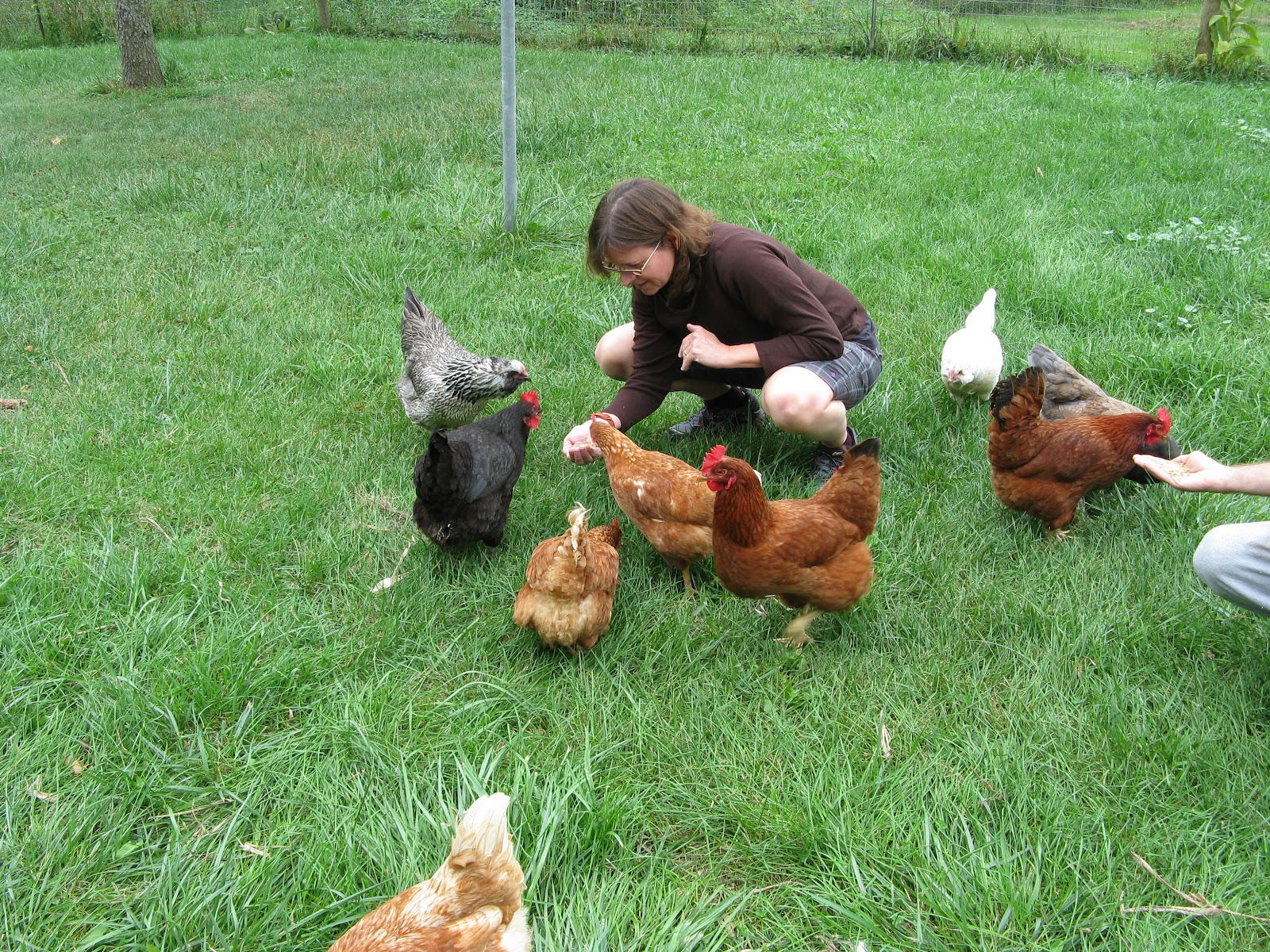 |
| Here chicken, chicken! At the farm. |
 |
| Jon feeds a hen that Mrs Wright would have liked. |
I hadn't been to the farm in a while so we had Bob show us some of the changes they've made, including the hen house and enclosed area. We fed the hens some chicken feed and a few of the grapes that grow next to the garage. Eventually, it started to sprinkle and Jon and I were ready to head out. Bob gave us some homemade grape jelly to take home. Pretty nice.
We had the Atlas & Gazetteer with us in the car, so we navigated our way along some backroads that I used to drive or travel while riding the school bus. The big change is that now all those backroads have been paved. I caught myself many times imagining biking along the long wooded ridges, past farm fields, barns and homes. Considered the steep hills to climb or descend. In Wisconsin, good roads are necessary to get milk to the dairies quickly; a farmer can only store so much milk in the bulk tank. But when I was growing up most of these old township roads were still gravel - including Brown Road, where the farm is. I imagine a bike tour from cheese factory to tavern would make for quite a fun trip.
I guess this is part of my continued shoulder recovery and my increased desire to be ready for a long ride. I see a perfect (or even not-so-perfect) road and want to feel wind in my face that is not coming from the air conditioner. I see uphills as a cyclist would, imagining the gear and power I'd need to get to the top. Maybe next time we go to Wisconsin we'll take bikes along. It would make the backroad tours that much more fun.
Subscribe to:
Posts (Atom)